

What Has Been Confirmed
Based on publicly available information and confirmation from individuals familiar with Paulding County development activity, there is confirmed intent for a data center to be developed on Cole Lake Road, on property that was previously approved for a large residential subdivision.
Under current zoning regulations, a data center is an allowed use on this property and would not require rezoning, meaning the project could move forward without the traditional rezoning process that typically triggers broader public awareness or hearings.
This information has also been independently confirmed by a government official. Names are intentionally not being shared. The purpose is not to expose individuals or speculate, but to ensure the community understands the type of development being discussed and how existing zoning processes work.
At this time, this should be understood as intent, not a finalized public announcement or completed project.
Why Paulding County Is Being Looked At
Source:
• GreyStone Power – Setting Strategy: Powering Data Centers While Safeguarding Co-op Members
https://www.greystonepower.com/setting-strategy-powering-data-centers-while-safeguarding-co-op-members
• Meeting Focuses on Georgia’s Data Center Growth
https://www.gacities.com/articles/meeting-focuses-on-georgias-data-center-growth
• AJC reporting on regional data center growth
https://www.ajc.com/business/2026/01/georgia-us-builders-bullish-on-data-centers-but-economic-fears-grow/
Paulding County is not alone. Across Georgia, data center development is expanding outward from metro Atlanta into surrounding counties where land availability, zoning allowances, and electrical infrastructure make large-scale facilities feasible.
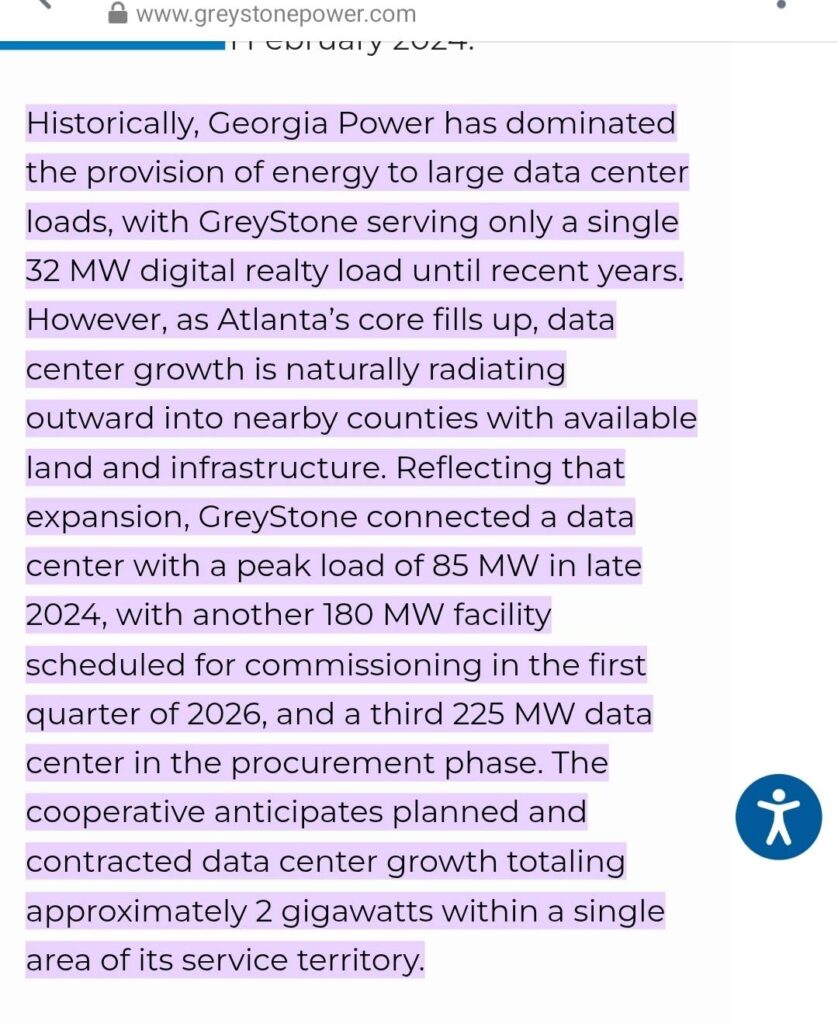
GreyStone Power, the electric cooperative that serves parts of Paulding County, has publicly discussed its growing role in supporting data center expansion as Atlanta’s core areas reach capacity. According to GreyStone and regional reporting, this growth is part of a broader shift affecting counties such as Paulding, Carroll, and Douglas.
Publicly reported details include:
• An 85 megawatt (MW) data center connected in late 2024
• A 180 MW data center planned for early 2026
• A third facility of approximately 225 MW already in planning
• Long-term projections in some areas reaching gigawatt-level power demand
To put this in perspective, a single 100 MW data center can consume as much electricity as tens of thousands of homes. GreyStone has stated publicly that it is investing heavily in grid infrastructure to support this growth while also working to safeguard reliability and cost impacts for existing co-op members.
This information reflects regional energy and infrastructure planning trends, not a single isolated project.


Understanding What a Data Center Is
A data center is a large industrial facility that houses servers and digital infrastructure supporting cloud computing, artificial intelligence, data storage, and online services. These facilities operate 24 hours a day, 7 days a week, and typically require:
• Massive and consistent electrical power
• Industrial-scale cooling systems
• Backup generators and fuel storage
• Continuous infrastructure and utility support
While data centers can bring economic benefits such as tax revenue and construction jobs, their physical footprint and operational needs differ significantly from residential or traditional commercial development.
Learning From Other Communities
Across Georgia and the Southeast, communities have shared experiences after data centers were built near residential areas. In at least one documented case, residents living a few hundred yards from a large data center reported impacts they did not fully anticipate, including continuous industrial noise, visual changes to the landscape, and infrastructure strain.
Importantly, these projects followed zoning rules and legal requirements. The concern raised by residents was not legality, but lack of early understanding and awareness.
This article does not suggest the same outcomes will occur in Paulding County. Rather, it highlights why communities benefit from learning about potential development before projects are finalized, allowing for informed questions, dialogue, and planning.

For additional context, the following video reflects the experience of residents in another community where a data center was built near residential homes. This example is shared for educational purposes only and does not suggest the same outcome would occur in Paulding County.
Why Awareness Matters
Data center development is reshaping Georgia’s energy and land-use landscape. Statewide reporting shows utilities are planning for unprecedented increases in electricity demand driven largely by data centers and artificial intelligence infrastructure. These changes raise important questions about long-term planning, infrastructure investment, and community impact.
Awareness does not equal opposition. It allows residents to understand what is permitted under current zoning, how decisions are made, and what questions may be appropriate to ask early in the process.
Informed communities are better positioned to participate constructively in conversations that affect their future.
Sources Referenced
• GreyStone Power – Public statements and reporting on data center infrastructure planning
• Regional reporting from Data Center Dynamics and AJC.com
• Public zoning allowances and land-use regulations
• Community experience reporting shared for educational context