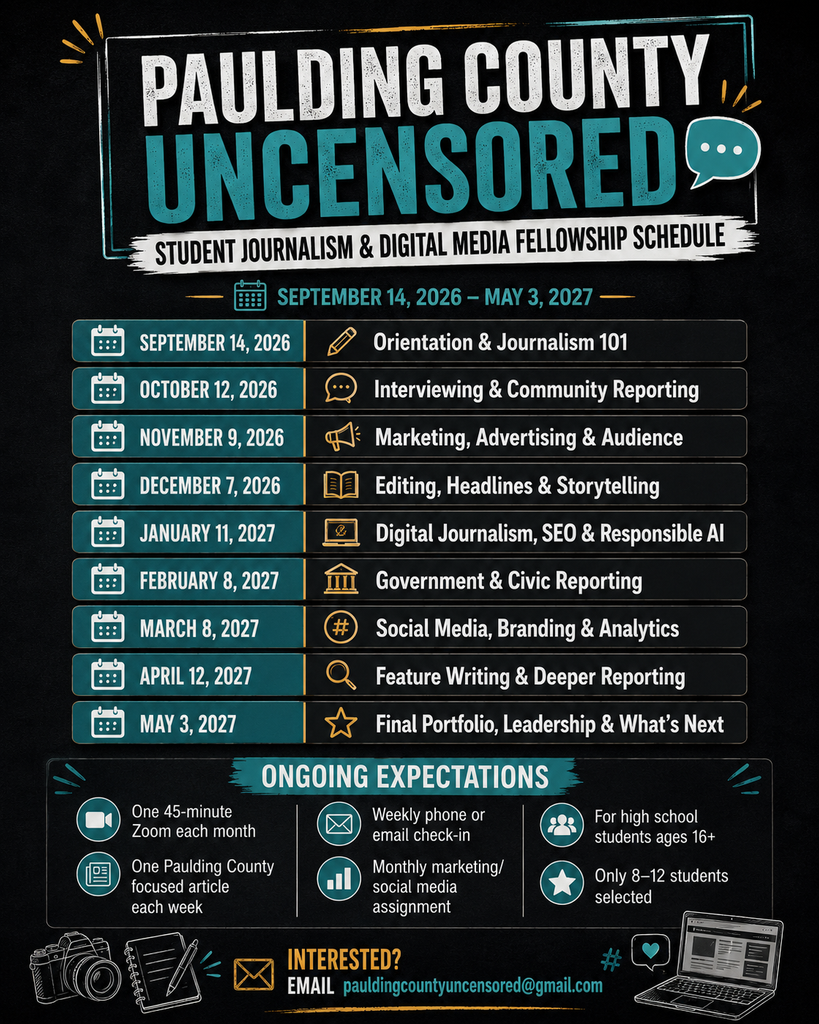
I am really excited to finally share something I have been putting a lot of thought into. Beginning September 14, 2026, I am launching the first Paulding County Uncensored Student Journalism and Digital Media Fellowship for high school students aged 16 and older.
The program will run from September 14, 2026, through May 3, 2027, and I am only accepting 8 to 12 students for our first group.
I am keeping it small on purpose.
I do not want this to become another program where students sign up, sit through a meeting once a month, get a certificate at the end, and nobody really knows what they learned. I want to actually work with these students, read what they write, give them feedback, answer their questions, help them develop stronger communication skills, and give them an opportunity to create something they can be proud to show a college, scholarship committee, employer, or future internship.
So who am I, and why am I doing this?
For those who do not know me personally, I am Stormy Curtis, the owner of Paulding County Uncensored.
I have spent years working with businesses, community members, real estate professionals, organizations, and people throughout our area. Through Paulding County Uncensored, I have had a front-row seat to how people communicate, how quickly information spreads, how stories develop, how businesses market themselves, and how differently people respond to information depending on how it is presented.
I also have a background in business consulting, marketing, advertising, public speaking, and business development.
I own Buy Georgia Realty, so marketing and advertising are a huge part of what I do every single day. Real estate is not simply putting a sign in a yard and waiting for somebody to call. You have to understand your audience, create messaging people actually want to read, market properties and people correctly, communicate professionally, negotiate, write, advertise, speak with the public, understand social media, and know how to present information in a way that gets attention without losing credibility.
The same is true in business consulting. You can have the greatest product, service, organization, or idea in the world, but if you do not know how to communicate it, market it, explain it, or reach the right audience, people may never know it exists.
That combination of community involvement, journalism-style communication, marketing, advertising, business, real estate, social media, and public speaking is really what inspired this program.
I want to take what I have learned over the years and give local students the opportunity to learn it much earlier than I did.
This is not just a writing club
Writing will absolutely be a major part of the program, but this is about much more than writing an article.
Students will learn how to find a story, research it, determine whether information is credible, ask questions, interview people when appropriate, verify facts, organize information, write clearly, create headlines, edit their work, and communicate professionally.
They will also learn about marketing, advertising, branding, social media, search engines, audience engagement, analytics, responsible use of artificial intelligence, public speaking, and how businesses communicate differently from journalists.
One of the biggest things I want students to understand is the difference between something being popular and something being accurate.
We live in a time when somebody can post something online, and within minutes, hundreds or thousands of people may believe it.
Students need to know how to ask, “Where did this information actually come from?”
They need to understand that a screenshot is not always a source, a rumor is not a fact, and artificial intelligence can absolutely give you information that sounds convincing and is still completely wrong.
Those are skills that matter whether a student becomes a journalist, attorney, business owner, marketer, teacher, Realtor, politician, social media manager, doctor, engineer, or anything else.
What will students actually be doing?
We will meet by Zoom once each month for approximately 45 minutes.
I intentionally keep Zoom meetings short and focused because students already spend plenty of time in classes and meetings.
Our monthly Zoom will be where I teach the main topic for the month, answer questions, review examples, discuss what students are seeing in the community, and discuss upcoming assignments.
The real experience happens throughout the rest of the month.
Students will be expected to follow developments throughout Paulding County and produce approximately one original article each week.
That could include community events, local businesses, nonprofit organizations, interesting residents, school activities, student accomplishments, sports, local history, government, development, community resources, human-interest stories, or issues affecting people living here.
I want students to learn how to look around their own community and realize there are stories everywhere.
They will report to me weekly by phone and/or email. Sometimes that may simply be checking in about their topic. Other times, we may need to talk through a source, an interview, a question, a problem with an article, or a revision.
I also want students to learn that good writers rewrite.
Submitting something does not automatically mean it gets published.
Sometimes I may send it back and say, “Where did you get this information?”
Sometimes I may ask them to interview someone else.
Sometimes I tell them the first paragraph isn’t grabbing my attention.
Sometimes they may have to completely rethink the angle of the story.
That is part of learning.
Their work may actually be published
One of my favorite parts of this program is that students won’t spend the year writing assignments that disappear into a folder.
Approved articles may be published through Paulding County Uncensored for a real community audience.
Students will be able to have an approved byline showing that they wrote the article.
Parents will have input regarding how their student is publicly identified. Depending on what a family is comfortable with, that might be the student’s full name, first name and last initial, or another approved option.
Imagine being 16 or 17 years old and being able to show a college that you didn’t just take a writing course.
You actually researched community issues, interviewed people, wrote articles, worked with an editor, made revisions, met deadlines, and had your work published.
That is what I want these students to walk away with.
Marketing and advertising will be a big part of this too
Every month, students will also have a marketing or social media responsibility.
I want them to understand why people stop scrolling for one post and completely ignore another.
What makes someone click?
Why does one headline work better than another?
Who is the audience?
What message are we trying to communicate?
What photograph or graphic makes sense?
What is the call to action?
When should something be posted?
What happened after we posted it?
Did people read it?
Did they share it?
Did they comment?
Did they click through to something else?
Students will begin learning to interpret those results and understand what they mean.
They will learn about branding, advertising, business promotion, marketing strategy, audience development, social media content, and basic analytics.
They will also learn an extremely important distinction between journalism, marketing, and advertising.
Journalism is intended to inform.
Marketing is intended to reach and influence an audience.
Advertising is promotional communication.
Those worlds often overlap online, and young people need to understand when they are looking at information and when they are being marketed to.
We are going to talk about artificial intelligence
I am not interested in pretending AI does not exist.
These students are going to enter colleges and careers where artificial intelligence will likely be part of everyday life.
I would much rather teach them how to use it responsibly.
They may learn how AI can help brainstorm topics, organize ideas, develop potential interview questions, improve grammar, or suggest alternative headlines.
What they cannot do is ask AI to write an article and submit it as their own work.
More importantly, they will learn that anything AI tells them still has to be verified.
If AI gives you a statistic, date, law, quote, name, or claim, you need to know where that information came from before publishing it.
We will also talk about Paulding County itself
I want these students to become more aware of the community they live in.
That means we may discuss county government, the cities within Paulding County, school issues, public meetings, community organizations, zoning, growth, development, local businesses, nonprofits, and community events.
This is not about teaching students what political opinions they should have.
It is about teaching them how to research information and understand the difference between documented information and someone’s opinion.
I think that is an incredibly important skill right now.
Who can apply?
The program is open to high school students aged 16 and older.
Students can attend Paulding County public schools, private schools, online schools, homeschool programs, homeschool academies, or co-ops.
Parent or guardian permission will be required for every student.
Students do not have to be amazing writers already.
I actually want some students who want to become better writers.
What matters more to me is whether they are curious, dependable, willing to learn, ask questions, accept feedback, and meet deadlines.
I want students who are interested in the world around them.
Only 8 to 12 students will be selected
This first group will be intentionally small.
I want enough students to create a fun newsroom environment, but not so many that I cannot actually work with them.
The students chosen for this first year will also be our Founding Fellows.
That means future students may participate in this program, but there will only ever be one original group that helped launch it.
What will students learn throughout the year?
September will focus on journalism basics, finding stories, facts versus opinion, sources, verification, plagiarism, writing structure, deadlines, and professional expectations.
October will focus more heavily on interviewing, community reporting, asking better questions, using quotations correctly, and communicating with sources.
November will introduce marketing, advertising, audiences, branding, promotional writing, social media, and how businesses communicate.
December will focus on editing, storytelling, stronger openings and headlines, organization, and learning how to improve what they have already written.
January will focus on digital journalism, search engines, SEO, keywords, online discoverability, and the responsible use of AI.
February will focus more heavily on local government and civic reporting. Students will learn how to find reliable government information, understand public meetings and agendas, research local issues, and distinguish factual information from commentary.
March will focus on social media, branding, marketing strategy, content calendars, engagement, and analytics.
April will focus on stronger feature writing and deeper community stories that may require multiple sources, more research, more interviews, and stronger storytelling.
May will focus on their final portfolio, leadership, resumes, college applications, scholarship applications, professional communication, and learning how to explain everything they accomplished.
The program officially concludes on May 3, 2027.
What will students have when they finish?
Students who successfully complete the program will have more than a certificate.
They will receive documentation showing what they actually accomplished.
That will include a Certificate of Completion or, when appropriate, a Certificate of Distinction.
They will also receive a Student Fellowship Achievement Record showing their program participation, verified hours, published work, marketing assignments, training, leadership, and overall performance.
Students will maintain a portfolio of their strongest published work and digital media projects throughout the year.
I will also document the actual hours students spend researching, writing, interviewing, editing, attending Zoom meetings, working on marketing projects, and completing other fellowship responsibilities.
Students who truly stand out through their professionalism, effort, reliability, leadership, and quality of work may also receive a personalized letter of recommendation from me for college, scholarships, internships, or employment.
I want the student who works hard for eight months to have something meaningful to show for it.
Is this an accredited class?
No, and I want to be very clear about that.
Paulding County Uncensored is not an accredited school, and I am not going to call something accredited when it is not.
What I can provide is a structured curriculum, documented participation hours, completed assignments, published work, learning objectives, an achievement record, a certificate, and a portfolio.
For homeschool students, parents can use that documentation when determining how they want to incorporate the experience into their student’s homeschool education or elective records.
I have also reached out to the Paulding County School District regarding the program to explore whether eligible students could eventually receive recognition through Work-Based Learning or another appropriate educational partnership.
That process is separate from admission into this program, and no school credit is guaranteed.
Student safety matters
These are still high school students, and that will always matter more than getting a story.
Students will not be expected to meet unknown adults alone in private locations.
They will not be sent into unsafe situations.
They will not be expected to cover active crime scenes.
They will not be given unrestricted responsibility for managing angry adults on Facebook.
They will not be expected to expose personal information about themselves or other minors.
Anything created for Paulding County Uncensored will remain subject to adult review before publication.
Parents will receive a permission form explaining publishing, bylines, photography, social media, interviews, communication, safety expectations, and student conduct before their child begins.
Why should a student consider applying?
Maybe you want to become a journalist.
Maybe you want to become an attorney.
Maybe you love marketing.
Maybe you want to own a business.
Maybe you are interested in politics, government, public relations, social media, advertising, communications, or English.
Maybe you have absolutely no idea what you want to do after high school.
That is okay too.
This program is really about learning how to think, research, communicate, ask better questions, work with others, accept feedback, meet deadlines, understand an audience, and become more confident in presenting information.
Those skills travel with you almost anywhere.
By May, I do not want these students saying, “I joined a writing program.”
I want them to be able to say, “I was selected for a community journalism and digital media fellowship. I researched and published articles, interviewed sources, learned marketing and advertising, created social media content, studied SEO and artificial intelligence, met publication deadlines, received editorial feedback, and built a professional portfolio.”
There is a big difference between those two experiences.
Interested in becoming one of our Founding Fellows?
The Paulding County Uncensored Student Journalism and Digital Media Fellowship begins September 14, 2026, and ends May 3, 2027.
Applicants must be high school students aged 16 or older and must have a parent or guardian’s permission.
Students should be willing to attend one 45-minute Zoom instructional meeting each month, complete weekly community reporting, communicate weekly by phone and/or email, participate in monthly marketing and social media assignments, accept feedback, make revisions when necessary, and meet program expectations.
Only 8 to 12 students will be selected for the inaugural class.
If you are a student who likes asking questions, writing, talking to people, researching things, figuring out how businesses grow, understanding social media, learning how advertising works, or simply becoming a better communicator, I would love for you to apply.
Students or parents can email pauldingcountyuncensored@gmail.com with the student’s name, grade, school or homeschool information, and a brief note on why they would like to participate.
You do not have to walk into this already knowing how to do it all.
That is what I am here to teach you.